Friday, May 15, 2015

Osmotic Pressure Calculation

By thermodynamics, the chemical potential of solvent (water) in a solution containing pure solvent and solute is expressed as,

\[ \mu_{w}\left(l,x_{w},p+\pi\right)=\mu_{w}^{0}\left(l,p+\pi\right)+\nu RT\ln a_{w}
\]

where, $\mu_w$ is the chemical potential of solvent, which is a function of solvent, $l$, mole fraction of solvent $x_w$, external pressure, $p$, and additional osmotic pressure exerted by solutes, $\pi$ (whereas, for the pure solvent, $x_w$ goes away); $\nu$ is the dissociation coefficient (a solute dissociates into $\nu$ ions); $R$ is the gas constant; $T$ is temperature in consistent with $R$; $a_w$ is water activity.

The addition to the pressure is expressed through the expression for the energy of expansion:

\[ \mu_{w}^{o}(l,p+\pi)=\mu_{w}^{0}(l,p)+\int_{p}^{p+\pi}V\mathrm{d}p
\]


where, $V$ is the molar volume of solvent.

To balance the chemical potentials of solvent for two solutions with and without solute separated by semipermeable membrane, $\mu_{w}\left(l,x_{w},p+\pi\right)$ and $\mu_{w}\left(l,p\right)$,

\[ -\nu RT\ln a_{w}=\int_{p}^{p+\pi}V\mathrm{d}p

\]

Thus, osmotic pressure is expressed as opposed to pure solvent (water), in which water activity is 1,

\[ \pi=-\nu RT/V\ln a_{w}

\]

Conventionally, the gradient of osmotic pressure is approximated using the concentration or the mass fraction of solute (salt). The derivation is shown as follows.

A definition of water activity is,

\[ a_{w}=l_{w}x_{w}=l_w(1-x_s)
\]


where, $l_w$ is activity coefficient; and $x_w$ is the mole fraction of water in aqueous fraction ($x_s=1-x_w$ is the mole fraction of solute). By Raoult's law, $l_w$ is usually approximated as unity in dilute solution.

Using Taylor series, $\ln l_w(1-x_s) \approx -x_s$.

Thus, the osmotic pressure becomes ($C$ is the molar concentration of solute),

\[ \pi=-\nu RT/V\ln a_{w} = \nu RT/V x_s = \nu RT C

\]


Also, the relation between the gradients of osmotic pressure and chemical potential is,

\[ \nabla\pi=-\frac{1}{V}\cdot\nabla\mu_{w}

\]

The relation between the gradient of osmotic pressure and the concentration or the mass fraction of solute (salt) becomes,

\[  \nabla\pi\approx\nu RT\nabla C=\nu RT\frac{\rho}{M_{s}}\nabla X
\]


where, $\rho$ is the solution density; $M_s$ is molar mass of solute; and $X$ is the mass fraction of solute.

Monday, March 23, 2015

Effects of Cryogenic Fluids as A Fracturing Fluid - T. Patterson defense

233 bans or severe hindrances in municipalities across US
See www.foodandwaterwatcj.org/water/fracking

Non-water-based fracking
1. Gelled liquid CO2 (Gupta, 1998)
2. Cryogenic (Grundman, 1998)


Saturday, March 14, 2015

Determine the rock mechanic properties for paleo-times

Example from William Fork in Piceance Basin from Cumella and Scheevel, 2008

Evidences to determine the rock mechanic properties in paleo-times, whether it behaves elastically or not, can include:
  • Present rock strain-recovery test see if it is elastic recovery.
  • Determine the time span for the study, whether it is short or long time. For example, natural fractures generated during gas generation by coal.
  • Low or negligible thermal effects
If the time span of the study in the paleo-times is relative short and present strain-recovery is elastic from core test, it can be assumed that the rock behaved elastically during that time span. Otherwise, non-elastic effects can play a role, such as pressure-solution, which can dissipate the stress during that process and result in non-elastic behavior.

Thursday, March 12, 2015

Unit Conversion Coefficients in oil and gas engineering equations

Flow Rate Conversion:

According to,
\[ 1 m^3/s = 543440 bbl/day
\]

\[ 1 cm^3/hr = (543440)(10^{-6})/3600 bbl/day
\]

Thus,

\[ 1 bbl/day = (3600)(10^6)(543440) = 6624.46 cm^3/hr
\]

Alternatively,

\[ 1 bbl  = 0.158987 m^3
\]

Thus,

\[ 1 bbl/day = (0.158987)(10^6)/(24) = 6624.46 cm^3/hr
\]

If the fluid is water with density of $1 g/cm^3$,

\[ 1 bbl/day = 6624.46 g/hr
\]

Multiply specific gravity, SG, to covert to other fluids.

Darcy Equation Radial Flow:

\[ q_{well}=-0.006328\frac{2\pi kh\left(p_{e}-p_{well}\right)}{B\mu\ln\left(r_{1}/r_{w}\right)}=-0.039765\frac{kh\left(p_{e}-p_{well}\right)}{B\mu\ln\left(r_{1}/r_{w}\right)}
\]

where, the conversion factor,

\[\frac{[mD][psi]}{[cp]}= \frac{0.9869233 \times 10^{-15} \times 10.7639[ft^2][psi]}{10^{-3} \times 0.000145038 [psi] \frac{1}{60\times 60\times 24}[day]} =  0.006328 \frac{[ft^{2}]}{[day]}
\]

\[ 0.006328\frac{[mD][ft][psi]}{[cp]}=\frac{[ft^{3}]}{[day]}
\]

If using $bbl/day$ instead of $ft^3/day$, $1\,bbl=5.6146\,ft^{3}$.

\[ \frac{0.006328\times2\pi}{5.146}=0.001127\times2\pi=0.007082=\frac{1}{141.2}
\]

thus,

\[ q_{well}=-\frac{kh\left(p_{e}-p_{well}\right)}{141.2B\mu\ln\left(r_{1}/r_{w}\right)}

\]

However, for gas flow, the bottomhole flow rate has to be converted to standard conditions ($T_{sc}=60 F = 520 R$ and $P_{sc} = 14.7 psi$).

\[ q_{g}=\frac{p_{sc}}{T_{sc}}\frac{zT}{p}q_{g,sc}
\]

Substitute in horizontal radial flow equation (steady-state, homogeneous):

\[ \frac{p_{sc}}{T_{sc}}\frac{zT}{p}q_{g,sc}=\frac{0.006328\times\left(2\pi rh\right)k}{\mu}\frac{dp}{dr}

\]

Integrate from wellbore to reservoir boundary:

\[ \frac{Tq_{g,sc}}{kh}\ln\left(\frac{r_{e}}{r_{w}}\right)=0.703\int_{p_{wf}}^{p}\frac{2p}{\mu z}dp

\]

Assume viscosity and z-factor are constant and ensure the unit of $q_{g,sc}$ is in $Mscf/day$ (thousand standard cubic feet per day):

\[ q_{g,sc}=\frac{kh\left(p_{ave}^{2}-p_{wf}^{2}\right)}{1424T\mu z\ln\left(\frac{r_{e}}{r_{w}}\right)}

\]

Diffusivity Equation:

Unit conversion factors of 0.006328 and 0.007082:

According to Darcy's law:

\[ q=0.001127\frac{kA\triangle p}{\mu L}
\]

where, $q$ is in $bbl/day$; $k$ is in $mD$; $\triangle p$ is in $psi$; $\mu$ is in $cp$; $L$ is in $ft$.

Due to the conversion of 1 $bbl$ = 5.6146 $ft^3/day$,

\[ q=(0.001127)(5.6146)\frac{kA\triangle p}{\mu L}=0.006328\frac{kA\triangle p}{\mu L}
\]

For radial flow of incompressible fluids:

\[ v=\frac{q}{A}=0.001127\frac{k}{\mu}\frac{dp}{dr}
\]

where, $A=2\pi rh$. Thus, by integration,

\[ \int_{r_{1}}^{r_{2}}\frac{q}{2\pi rh}dr=0.001127\int_{p_{1}}^{p_{2}}\frac{k}{\mu}dp
\]

Hence,

\[ q=(2\pi)(0.001127)\frac{kh\triangle p}{\mu\ln(r_{2}/r_{1})}=0.007082\frac{kh\triangle p}{\mu\ln(r_{2}/r_{1})}
\]

where, $q$ is in $bbl/day$; $k$ is in $mD$; $\triangle p$ is in $psi$; $\mu$ is in $cp$; $L$ is in $ft$.

Gas Diffusion and Adsorption:

Diffusion Coefficient:

\[ D^{k*}=10^3\frac{b^K k^\infty}{\mu}
\]

where, $D^{k*}$ in $cm^2/s$, $b^K$ in atm, k in mD, $\mu$ in cp = $mPa \cdot s$, so

\[ cm^2/s=10^3\frac{atm \cdot mD}{cp}=10^3\frac{10^5Pa \cdot 10^{-12} m^2}{10^{-3}Pa\cdot s}=10^{-4}m^2/s
\]

Multiply by $(93)$ convert from $cm^2/s$ to $ft^2/day$.

Gas Diffusion: 

Solute Concentration:

Molality:
Also called molal concentration, is a measure of the concentration of a solute in a solution in terms of amount of substance in a specified amount of mass of the solvent.
A commonly used unit is mol/kg. A solution of concentration 1 mol/kg is also sometimes denoted as 1 molal.

The molality ($b$), of a solution is defined as the amount of substance (in $mol$) of solute, $n_{solute}$, divided by the mass (in $kg$) of the solvent, $m_{solvent}$:

\[ b = \frac{n_{solute}}{m_{solvent}}
\]

Molarity:
Molar concentration, also called molarity, amount concentration or substance concentration, is a measure of the concentration of a solute in a solution, or of any chemical species in terms of amount of substance in a given volume. A commonly used unit for molar concentration used in chemistry is mol/L. A solution of concentration 1 mol/L is also denoted as 1 molar (1 M).

Molar concentration or molarity is most commonly expressed in units of moles of solute per litre of solution. For use in broader applications, it is defined as amount of solute per unit volume of solution, or per unit volume available to the species, represented by lowercase $c$:

\[ c = \frac{n}{V} = \frac{N}{N_{\rm A}\,V} = \frac{C}{N_{\rm A}}
\]

Here, $n$ is the amount of the solute in moles, $N$ is the number of molecules present in the volume $V$ (in litres), the ratio $N/V$ is the number concentration $C$, and $N_A$ is the Avogadro constant, approximately $6.022×10^{23} mol^{−1}$.

Or more simply: 1 molar = 1 M = 1 mole/litre.

PPM (parts-per-million):
Parts-per notation is often used describing dilute solutions in chemistry. When working with aqueous solutions, it is common to assume that the density of water is 1.00 $g/mL$. Therefore, it is common to equate 1 gram of water with 1 mL of water. Consequently, $ppm$ corresponds to 1 $mg/L$ and $ppb$ corresponds to 1 $μg/L$.

Conversions:

The conversions to and from the molar concentration, $c$, for one-solute solutions are

\[ c = \frac{\rho\, b}{1+ b M},\ b=\frac{c}{\rho-cM}
\]

where $\rho$ is the mass density of the solution, $b$ is the molality, and $M$ is the molar mass of the solute.

To be exact, ppm is interchangeable with molality solute through molecular weight,

\[ 1 ppm = \frac{10^{3} mol/kg}{M_w}
\]

Because it is usually easier to measure liquids by volume instead of mass, molarity (M) is defined as the number of moles of solute ($n$) divided by the volume ($V$) of the solution in liters. Thus,

\[ 1 ppm = \frac{10^{3} mol/L}{M_w}
\]

This is only valid for dilute solution. As salt concentration increases, the volume of solution varies (larger or smaller) and the deviation enlarges.

Friction Pressure:


Friction Head Loss:

\[
h_{f}=\frac{2f_{f}V^{2}L}{g_{c}d}
\]


where, $f_{f}$ is Fanning Friction Factor, quarter of Moody Factor.

Friction Pressure:

\begin{eqnarray*}
p_{f} & = & \frac{2f_{f}V^{2}\rho L}{d}=\frac{2f_{f}(q/A)^{2}\rho L}{d}=\frac{2f_{f}(\frac{4q}{\pi d^{2}})^{2}\rho L}{d}=2\frac{16}{\pi^{2}}\frac{f_{f}q^{2}\rho L}{d^{5}}\\
& = & 2\frac{16}{\pi^{2}}\frac{\left[bpm\right]^{2}\left[lbm/ft^{3}\right]\left[ft\right]}{[in]^{5}}=2\frac{16}{\pi^{2}}\frac{\left[\frac{5.6146ft^{3}}{60s}\right]^{2}\left[\frac{lbm}{ft^{3}}\right]\left[ft\right]}{[in]^{5}}\\
& = & 2\frac{16}{\pi^{2}}\frac{\left(\frac{5.6146}{60}\right)^{2}\left[ft^{3}\right]\left[lbm\frac{ft}{s^{2}}\right]}{[in]^{5}}=2\frac{16}{\pi^{2}}\left(\frac{5.6146}{60}\right)^{2}\frac{\left(12\right)^{3}\left[lbm\frac{ft}{s^{2}}\right]}{in^{2}}\\
& = & 2\frac{16}{\pi^{2}}\left(\frac{5.6146}{60}\right)^{2}\left(12\right)^{3}\frac{1}{32.174}\frac{lbf}{in^{2}}\\
& = & 1.52484psi
\end{eqnarray*}


Sunday, March 8, 2015

Force of Crystallization - Beef fracture and Nahcolite Nodules

Crystal of Nahcolite → High Crystallization Pressure → Nodules

Crystal of Calcite → Lower Crystallization Pressure → Contained within bedding-parallel fractures, grows as vein and forms the beef fractures.
1

Analysis of the force of crystallization for both calcite and nahcolite was presented as a function of the degree of solution supersaturation and the partial molar volume change of the precipitated mineral. The pressure generated from crystal growth of nahcolite is significantly higher than what calcite crystal growth can generate. This implies that crystallization forces significantly exceeding the in-situ stress condition (i.e., the crystals cannot be contained within the vein) create the widely observed large sizes of nahcolite nodules. However, calcite is usually observed as veins, implying that the forces of calcite crystallization are probably contained with the bedding-parallel fractures forming the widely observed beef fractures.

Vein

In geology, a vein is a distinct sheetlike body of crystallized minerals within a rock. Veins form when mineral constituents carried by an aqueous solution within the rock mass are deposited through precipitation.

Fibrous mineral veins generally grow by precipitation from supersaturated aqueous solutions.The force of crystallization as a function of the degree of solution supersaturation (ratio of the actual concentration to the concentration in a normal saturated solution) and the partial molar volume change of the precipitated mineral.

vein

Natural Forces in Fracturing Systems

Natural forces acting in a sedimentary basin can be grouped into two categories: (1) external forces and (2) internal forces.

External forces, which are created by sediment load and tectonics, are dominant during early burial.

Continuous pressure release exists, creating equilibrium with a hydrostatic pressure. With subsequent burial, both temperature and pressure increase. However, porosity and permeability decrease. Pressure release is limited because of the limitations of decreasing porosity and permeability. At that point, internal forces, which are caused by clay inter-layer reactions, mineral crystallization or petroleum generation, will dominate.

1

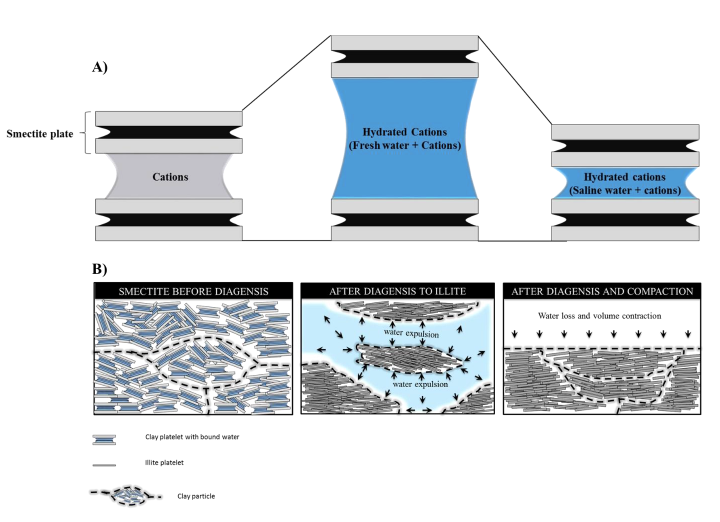
  • Force of clay inter-layer reactions:
    Interaction between swelling clay and water can generate forces that cause rock volume contraction and water expulsion during both early and late diagenesis.

2

  • Force of crystallization:
    The mineral crystallization-generated force is a consequence of precipitation from supersaturated solution and crystal growth causing a rock volume expansion .

3

  • Force of petroleum expulsion:
    The petroleum expulsion-generated force is a consequence of kerogen maturation and petroleum generation causing rock volume expansion.

4