Showing posts with label Geomechanics. Show all posts

Monday, October 9, 2017

Viscoplasticity and

Viscoplasticity is a theory in continuum mechanics that describes the rate-dependent/time-dependent inelastic behavior of solids.

The inelastic behavior that is the subject of viscoplasticity is plastic deformation which means that the material undergoes unrecoverable deformations when a load level is reached. Rate-dependent plasticity is important for transient plasticity calculations. The main difference between rate-independent plastic and viscoplastic material models is that the latter exhibit not only permanent deformations after the application of loads but continue to undergo a creep flow as a function of time under the influence of the applied load.

The elastic response of viscoplastic materials can be represented in one-dimension by Hookean spring elements. Rate-dependence can be represented by nonlinear dashpot elements in a manner similar to viscoelasticity. Plasticity can be accounted for by adding sliding frictional elements as shown in Figure 1.[2] In the figure E is the modulus of elasticity, λ is the viscosity parameter and N is a power-law type parameter that represents non-linear dashpot [σ(dε/dt)= σ = λ(dε/dt)(1/N)]. The sliding element can have a yield stress (σy) that is strain rate dependent, or even constant, as shown in Figure 1c.


Viscoelasticity is the property of materials that exhibit both viscous and elastic characteristics when undergoing deformation. Viscous materials, like honey, resist shear flow and strain linearly with time when a stress is applied. Elastic materials strain when stretched and quickly return to their original state once the stress is removed.

Viscoelastic materials have elements of both of these properties and, as such, exhibit time-dependent strain. Whereas elasticity is usually the result of bond stretching along crystallographic planes in an ordered solid, viscosity is the result of the diffusion of atoms or molecules inside an amorphous material.[1]

Viscoplasticity
Viscoelasticity

Friday, February 24, 2017

Rock Brittleness

Definition:

  • Brittle rocks undergo little or no ductile deformation past the yield point (or elastic limit) of the rock.
  • Brittle rocks absorb relatively little energy before fracturing.
  • Brittle rocks have a strong tendency to fracture.
  • Brittle rocks have a higher angle of internal friction

Brittleness in Mining Industry:

Some authors in the mining industry define brittleness index B (loosely defined, but the concept is also called brittleness ratio, brittleness coefficient, or ductility number) as the ratio of uniaxial compressive strength to tensile strength.

\[ B = \frac{\mathrm{compressive}\ \mathrm{strength}}{\mathrm{tensile}\ \mathrm{strength}} = \frac{\sigma_\mathrm{C}}{\sigma_\mathrm{T}}
\]

Altindag (2003) also gives:

\[ B = \frac{\sigma_\mathrm{C} - \sigma_\mathrm{T}}{\sigma_\mathrm{C} + \sigma_\mathrm{T}} \]

Altindag (2002 and 2003) further showed that the most useful measure may be the mean average of compressive and tensile strength:

\[ B = \tfrac12 \times (\sigma_\mathrm{C} + \sigma_\mathrm{T})  \]

Tensile strength is usually correlated with compressive strength, and it may be possible to use just one of these measures as a proxy for brittleness. This is good, because some (most?) labs only measure compressive strength as a standard test, e.g. in routine triaxial rig tests.

Brittleness in Geophysics:

Rickman et al. 2008 proposed using Young's modulus E and Poisson's ratio ν to estimate brittleness. This is appealing to development geophyisicists because elastic moduli are readily available from logs and accessible from seismic data via seismic inversion. Two recent examples are Sharma & Chopra 2012 and Gray et al. 2012. Gray et al. gave the following equations for 'brittleness index' B:

\[ B=50\% \times \left(\frac{E_{\mathrm{min}}-E}{E_{\mathrm{min}}-E_{\mathrm{max}}}+\frac{\nu_{\mathrm{max}}-\nu}{\nu_{\mathrm{max}}-\nu_{\mathrm{min}}}\right) \]

However, this approach remains skeptical, which assumes that a shale's brittleness is (a) a tangible rock property and (b) a simple function of elastic moduli. Computing shale brittleness from elastic properties is not physically meaningful, stated by Lev Vernik stated at the SEG Annual Meeting in 2012.

Saturday, March 14, 2015

Determine the rock mechanic properties for paleo-times

Example from William Fork in Piceance Basin from Cumella and Scheevel, 2008

Evidences to determine the rock mechanic properties in paleo-times, whether it behaves elastically or not, can include:
  • Present rock strain-recovery test see if it is elastic recovery.
  • Determine the time span for the study, whether it is short or long time. For example, natural fractures generated during gas generation by coal.
  • Low or negligible thermal effects
If the time span of the study in the paleo-times is relative short and present strain-recovery is elastic from core test, it can be assumed that the rock behaved elastically during that time span. Otherwise, non-elastic effects can play a role, such as pressure-solution, which can dissipate the stress during that process and result in non-elastic behavior.

Sunday, March 8, 2015

Natural Forces in Fracturing Systems

Natural forces acting in a sedimentary basin can be grouped into two categories: (1) external forces and (2) internal forces.

External forces, which are created by sediment load and tectonics, are dominant during early burial.

Continuous pressure release exists, creating equilibrium with a hydrostatic pressure. With subsequent burial, both temperature and pressure increase. However, porosity and permeability decrease. Pressure release is limited because of the limitations of decreasing porosity and permeability. At that point, internal forces, which are caused by clay inter-layer reactions, mineral crystallization or petroleum generation, will dominate.

1

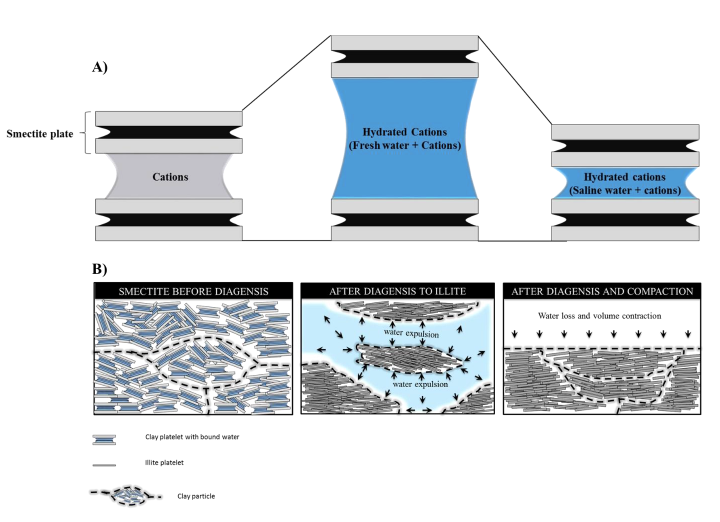
  • Force of clay inter-layer reactions:
    Interaction between swelling clay and water can generate forces that cause rock volume contraction and water expulsion during both early and late diagenesis.

2

  • Force of crystallization:
    The mineral crystallization-generated force is a consequence of precipitation from supersaturated solution and crystal growth causing a rock volume expansion .

3

  • Force of petroleum expulsion:
    The petroleum expulsion-generated force is a consequence of kerogen maturation and petroleum generation causing rock volume expansion.

4